%20(1).png)
Metropolis Archaeological Site
Updated: Jul 23

The archaeological site at Metropolis makes a good stop when travelling northwards from Kusadasi, Selcuk or Ephesus to Pergamon or Izmir. It's only a 40 minute drive from Ephesus to Metropolis and then an additional 2 hour drive to Pergamon.
It only takes an hour to visit Metropolis and the theatre, mosaics and bath complex are worth seeing. The site is still actively being excavated and additional areas will be open in future.
Contents
1. Brief History of Metropolis
The ancient city of Metropolis flourished under the Seleucid Empire (312 BC to 64 BC) and was part of the Kingdom of Pergamon. The grand theatre, stoa and temple dedicated to Ares were built during this period.
Under Roman rule, between the 1st and 3rd centuries AD, Metropolis outgrew its hillside fortifications and expanded downhill onto the fertile plain. The city flourished with grid-planned streets, peristyle mansions and lavish public bathhouses.
The city shrunk in the 3rd century AD following severe earthquakes and Gothic raids. It became an important Byzantine bishopric centre in the 6th century.
In the 13th century a sturdy fortress was built across the ancient ruins to defend against regional instability. After coming under the rule of the Aydınoğulları Beylik, and later the Ottoman Empire, the hillside site was eventually abandoned. The residents moved to nearby Torbali.
European travellers discovered the ruins in the 17th century and archaeological excavations have been uncovering the city since 1989.
2. Getting to Metropolis
Metropolis is a 1 hour drive south of Izmir and a 40 minute drive north of Ephesus. When driving northwards to Metropolis enter "Metropolis Antik Kenti" in Google Maps for directions.
We stopped off at Metropolis when driving from Selcuk to Pergamon and spent 1 hour there.

3. Opening Hours, Entry Fees and Facilities
It appears that the site is open from 08.30 to 19.00 in summer.
We visited in June 2026 and it was free. There will probably soon be an entrance fee as they have improved the infrastructure. There are good toilets, paths and steps, information boards, covered parking and a site office.
They sell bottles of water there but little else.
4. What to see at Metropolis
It took us one hour to visit Metropolis. The highlights are the theatre, 2 very good mosaics and an impressive bath complex.
The gate to the upper area containing the acropolis, fortress and bouleuteion was closed as excavations were still taking place.


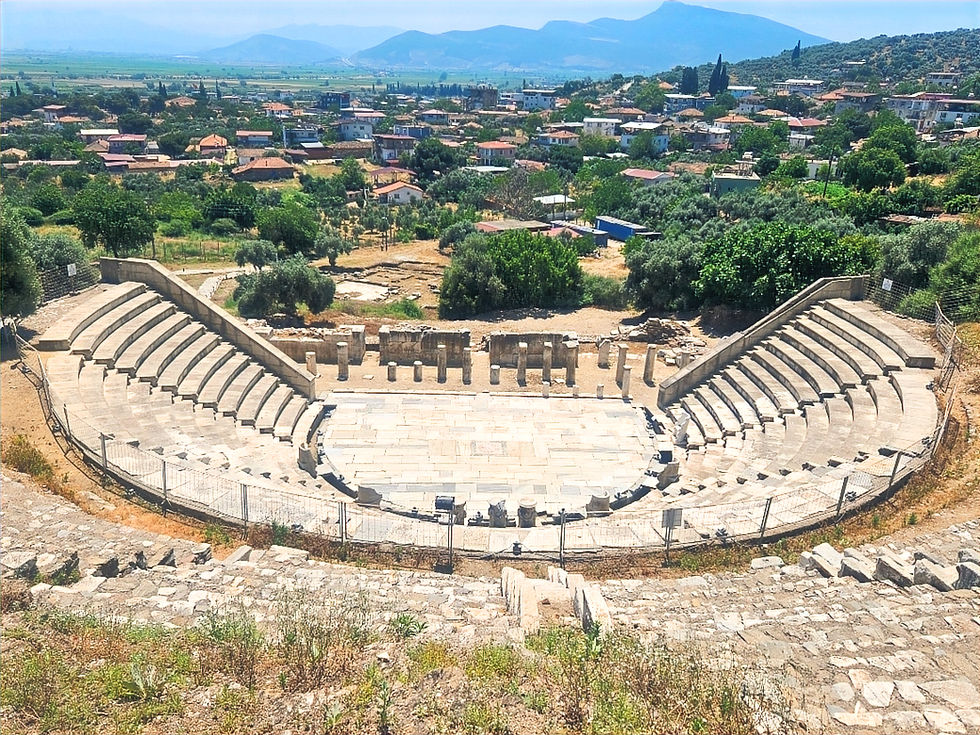
The Theatre at Miletus
The theatre at Metropolis was built into the natural hillside during the Hellenistic period (323 BC to 30 BC) and seated 8,000 to 10,000 people. The Romans made improvements to the theatre which included adding a marble floor and enlarging the stage building.
The theatre was fashioned from marble and consists of the orchestra, stage building and seating, with seats of honour in the front row. The seats of honour were reserved for clergy and emperors. They are very good examples of Hellenistic marble work and 2 of them are backed by reliefs of Zeus’s lightning beam and Ares' shield.
The theatre hosted Metropolis' social, cultural and artistic activities but lost its function in the early 5th century AD. It was restored in 2001 and now has a reduced seating capacity of approximately 4,000 people. The marble slabs for the upper seats were used for other buildings after the 5th century AD.


The Mosaic Hall
The mosaic hall is the feast hall of a residence built in the 2nd century AD to the east of the Metropolis Theatre. It has some of the best examples of intricate floor mosaics found in Western Anatolia.
The first panel is coloured with tragedy and comedy masks, fish, birds and flowers associated with theatre plays and performers.

The content of the second panel displays four portraits. They may symbolise the personified four seasons:
Spring is dressed in a blue-grey dress and holds a flower branch with insects on it as a sign of spring.
The winter figure is personified as a woman. Her head is covered with a mantle of leaves and branches of green grains embroidered in the background.
A portrait in a red tunic personifies autumn.
The image of summer hasn't survived.

Roman Baths & Palaestra
The Roman Baths and Palaestra were built during the reign of Roman Emperor Antoninus Pius (138-161 AD) and featured marble halls, heated bath chambers and a wrestling school. Stepped pools are on the sides of the central hall. The building complex was approximately 6,000 square meters. It was converted into small workshops in the Middle Ages.
One hall has an impressive Roman hypocaust heating systems. This system raised the building's floor with brick columns creating voids underneath. Hot air and smoke from a nearby furnace was circulated through these voids.
Public toilets for 25 people were part of the complex and can be seen in the south east corner.


Comments