%20(1).png)
2026 Travel Guide for Ephesus
Updated: Jul 24
Contents
1. Ephesus' Opening Hours and Ticket Prices
In Summer (April to October) Ephesus is open from 08.00 to 19.00 except for the Terrace Houses which close at 18.30. In winter Ephesus appears to be open from 08.30 to 17.00.
From 3rd June to 1st October 2026 Ephesus stays open for night visits until 23.00 on Wednesdays, Thursdays, Fridays and Saturdays. After 18.45 entry is only through the lower gate and the Terrace Houses remain closed after 18.30.
Ephesus isn't open for night visits during concert and event periods. In 2026 the last such event is meant to be on July 15th. However, I would be very wary about relying on that. It would be very disappointing to miss seeing Ephesus because of an additional event.
Tickets for the Ephesus archaeological site, excluding the Terrace Houses, cost EUR 40. If you want to visit the Terrace Houses the cost increases to EUR 52. Payment is in Turkish lira and credit cards are accepted.
I recommend paying the extra EUR 12 to see the Terrace Houses. I don't see the point of scrimping when you have come all the way here.

2. How to avoid the Crowds at Ephesus
Ephesus is unfortunately an extremely popular site and can be very crowded in summer. Curetes Street and Marble Road form the main thoroughfare through Ephesus and they are jammed with tourists at peak times. The Celsus Library becomes incredibly busy with everyone taking photos.
Massive cruise ships docked at nearby Kusadasi are the worse culprit. The day before we visited Ephesus there were 3 cruise ships with almost 10,000 passengers docked at Kusadasi. Over half those passengers would have visited Ephesus and mostly in the morning!
Crowds completely spoil the experience but they can be avoided with careful planning. We visited Ephesus in mid June 2026 and had the site to ourselves for 1.5 hours. It only became a bit busy at the end of our 3.5 hour visit. The first solitary 1.5 hours at Ephesus was a fantastic experience.
At the end of our visit I was intrigued to hear 2 tour leaders inform their groups how lucky they were to be at Ephesus when there weren't any visitors from cruise ships.
My advice for avoiding the crowds is:
Avoid the Cruise Ships at Kusadasi
Before booking your flights and accommodation find a day when there will be no cruise ships at Kusadasi for your visit to Ephesus. There are several websites that provide free information about cruise ships docked at ports and I use cruisetimetables.com.
This website states the number of passengers and arrival/departure times for each ship. It's crucial to look at cruise ship schedules as the majority of Ephesus' visitors are from a cruise ship.
If you can't find a suitable day without any cruise ships at least select a day with fewer passengers and later arrival times. Most cruise ships arrive at Kusadasi between 07.00 and 09.00.
I have never been on a cruise but we unfortunately our ferry from Samos arrived at Kusadasi when 3 cruise ships were docked there. It was absolute chaos at the port.
I am not sure how long it would take passengers who arrive at Kusadasi at 07.00 to disembark and join a tour bus to reach Ephesus. I guess that the tour buses would start arriving at Ephesus from about 08.30. This would negatively impact your visit if you visited Ephesus at 08.00 as I recommend.
Cruise ships docking at Kusadasi at 08.00, or later, shouldn't impact you if you visit Ephesus at 08.00. If you plan to visit in the late afternoon it's better if cruise ships are due to leave Kusadasi by 19.00.
Visit when Ephesus opens at 08.00
Most travel blogs recommend that you arrive at Ephesus on the dot of 08.00 and they are right! I wasn't going to do this as most hotels in nearby Selcuk only serve breakfast from 08.00. However, our hotel (in Ephesus Hotel and Art Galery) kindly offered to provide a fabulous breakfast at 07.00.
When we arrived at Ephesus shortly after 08.00 we were the only visitors there. We virtually had Ephesus to ourselves and it was an incredible experience walking down the deserted site. An early start also means that you avoid the heat of the day and Ephesus is an exposed site.
Most hotels won't offer an early breakfast. If so it is better to buy something the night before and eat it in your hotel room. It isn't worth missing the best time of day at Ephesus for a hotel breakfast.
Visit Ephesus after 15.30
If you can't visit Ephesus at 08.00 then it's better to visit after 15.30. Visitors from cruise ships will usually have returned to their vessels by then and most other tour groups will have completed their visits. It's also a bit cooler in the late afternoon.
Visit Ephesus in the Evening & Night
I considered visiting in an evening, when Ephesus was open until 23.00, but had some concerns about doing so. Firstly the Terrace Houses close at 18.30 and I wanted to see them. Secondly when we visited the Luxor Temple in Egypt at night it was very busy with tour groups and I was concerned Ephesus would be as well. Thirdly night viewings at Ephesus can be cancelled for events.
All the comments I have seen on the internet indicate that Ephesus isn't busy at night. However, for some reason photos taken of the Celsus Library at night always show a lot of people! Ephesus at night is definitely not as quiet as at 08.00.
I had considered visiting Ephesus both in the morning and at night as the illumination of the buildings provide a different perspective and they look magnificent lit up. The EUR 40 entry fee put me off from doing so!


Arrive at Ephesus' Upper Entrance
Most travel books and blogs recommend arriving at Ephesus' upper entrance and walking downhill to the lower entrance. Tour companies like doing this as it is less tiring for their customers. Coaches drop off their customers at the upper entrance and collect them at the lower entrance.
Normally I do the opposite of what tour groups do! However, if you enter Ephesus at 08.00 it's better to start at the upper entrance as otherwise you will meet the tour groups on your way up from the lower entrance. It's better to have the masses following you when they will be at least 1 hour 30 minutes behind you.
It's also a good idea to use the upper entrance if starting in the late afternoon to avoid any tour groups that have arrived later in the day.
People usually recommend entering at the Upper Entrance because it's easier walking downhill. At the end of our visit we walked back up the site in the mid June heat and it wasn't a problem at all. If the site was busy with tour groups it would be hassle passing them.
Visit the Celsus Library & Latrines before the Terrace Houses
When entering from Ephesus' upper entrance you reach the Terrace Houses before the Celsus Library. The latrines are more or less opposite the Terrace Houses.
It's better to visit the nearby Celsus Library and the Latrines before entering the Terrace House complex. It can take half an hour to properly see the Terrace Houses and if you visit the Celsus Library and the Latrines afterwards they will be busier.
The Celsus Library is the most popular building at Ephesus and some visitors spend a lot of time posing for photos there. In contrast not too many visitors enter the Terrace Houses because of the extra cost.
Don't Follow a Tour Group into the Terrace Houses
As mentioned earlier it is worth paying the additional EUR 12 to visit the Terrace Houses. However, as they are enclosed by one huge protective building sound travels around the complex. The loud voice of a tour group leader could spoil the experience.
When we were there most tour groups and other visitors didn't enter the Terrace Houses. If you are unlucky to arrive there at the same time as a tour group it's probably better to wait 15 minutes before entering.
Avoid Weekends during the Offseason
It's unlikely that many locals living in cities and towns like Kusadasi and Izmir would want to visit Ephesus during the peak summer months. They are far more likely to visit in the offseason on a Saturday or Sunday. Therefore during the off season try not to visit Ephesus at weekends.
3. Brief History of Ephesus
The colossal Temple of Artemis was constructed at Ephesus in 550 BC. It was four times the size of the Parthenon in Athens and was one of the Seven Wonders of the Ancient World.
In 356 BC Herostratus burnt the Temple of Artemis to the ground just to immortalise his name. When Alexander the Great conquered the region decades later he offered to fund the temple's rebuilding but the Ephesians politely declined and rebuilt it themselves.
In 286 BC sediment from the Cayster River began choking the harbour and the population moved to a newly walled city two miles away. This is where the famous ruins of Ephesus now stand.
Ephesus was absorbed into the Roman Republic in 133 BC. Its population expanded to roughly 250,000 people, making Ephesus the second-largest city in the Roman Empire after Rome.
In the mid 1st century AD Ephesus became a hub for early Christianity. The Apostle Paul lived and preached here for nearly three years. It's believed that Apostle John wrote his Gospel here and brought Mary, the mother of Jesus, to live out her final years in the nearby hills.
Ephesus' most iconic surviving monuments were constructed during the 1st and 2nd Centuries AD. The Library of Celsus holding over 12,000 scrolls was built and the Great Theatre was expanded to seat 25,000 spectators
In 262 AD the Goths sacked the city and destroyed the Temple of Artemis. Ephesus partially recovered under Byzantine rule but repeated earthquakes shattered its marble infrastructure.
Over the following centuries the Cayster River relentlessly deposited silt into Ephesus' harbour despite constant engineering efforts. The harbour was eventually transformed into a landlocked, malaria-ridden marsh. The remaining residents abandoned Ephesus in the 15th Century AD for the nearby fortified hill of Ayasuluk (modern Selçuk).
By the time the Ottoman Empire absorbed the region, ancient Ephesus lay buried under mud and sand. Because Ephesus was abandoned rather than continuously built over like Rome or Istanbul, its ruins were exceptionally preserved under the sediment.
Excavations at Ephesus started in the mid 19th century. It's one of the most complete ancient cities ever excavated.
4. How to reach Ephesus

Selcuk makes a good base and there are several good hotels. Ephesus is a 6 minute drive from Selcuk and a 30 minute drive from Kusadasi. It's possible to walk from Selcuk to Ephesus and it would take 40 minutes. Most people either take a taxi or drive.
A taxi from Selcuk to Ephesus should cost around EUR 8 (TRY 400). A taxi back to Selcuk might cost more as it's a captive market. We were charged EUR16 (TRY 800) from the upper entrance. There was only 1 taxi there and he showed us a rate sheet. Our hotel owner said there were more taxis at the lower entrance and they should be cheaper.
If you drive to Ephesus be aware that the route from Selcuk to Ephesus' upper and lower entrances is different. Enter "Ephesus Archaeological Site" in Google Maps for the upper entrance and "Ephese ticket office" for the lower entrance. There are car parks at both entrances and the cost is EUR 3 (TRY 150).
If you drive to Ephesus you would either have to walk back to the entrance you parked at or take a taxi back to your car. It takes 6 minutes to drive between the entrances so the taxi fare would probably be the same as from Ephesus to Selcuk.
5. Facilities at Ephesus
There are toilets at both of Ephesus' entrances but they can only be used before entering the site. There are also toilets at the Ephesus Experience Museum which is near the Selcuk Library The museum is included in the ticket price but I am not sure if you could use the toilets without seeing the boring show at the museum.
There is a refreshment stall at Hadrian's Gate which is near the Celsus Library. There is also a cafe at the Ephesus Experience Museum for visitors who watch the show.

6. What to see at Ephesus
We spent 3.5 hours at Ephesus and would have stayed longer if the Theatre hadn't been closed for renovations. We could have spent half an hour less at Ephesus if we hadn't wasted our time at the Ephesus Experience Museum.
The highlights of Ephesus are the Odeon, Temple of Hadrian, Terrace Houses, public latrines, Celsus Library and the Great Theatre. There are plenty of other interesting ancient structures to see.
There are 2 site maps below to help navigation through Ephesus. There are also photos and information on the important buildings. The order that they shown in is from the Upper Entrance to the Lower Entrance.


The Odeon
The Odeon of Ephesus (also known as the Bouleuterion) was built around 150 AD. It was designed to seat approximately 1,500 people. The structure functioned as both a covered concert hall and the council chamber. It hosted the 300 member aristocratic senate of Ephesus, who gathered to debate and decide on city affairs, taxation and public construction.

Temple of Domitian
The Domitian Temple was built in the 1st century AD and was dedicated to the Roman Emperor Domitian.
Domitian was one of the most brutal Roman emperors and persecuted many Christians. The unpopular emperor was eventually killed by one of his servants. The citizens of Ephesus celebrated and erased Domitian’s name from inscriptions around the city.
The Domitian Temple was destroyed after the 4th century AD when Christianity became the state religion.

Curetes Street
Curetes Street was one of the three main streets of Ephesus, connecting the Upper and Lower Agoras. It was named after the Curetes, a class of priests who played an important role in the religious life of Ephesus. The street was originally built during the Hellenistic period but was extensively renovated and adorned during the Roman era, particularly in the 1st and 2nd centuries AD.

Temple of Hadrian
This temple dedicated to the Emperor Hadrian is considered one of the best preserved and most beautiful structures on Curetes Street. It was constructed in the beginning of the 2nd century AD to celebrate Hadrian's visit. The temple was reconstructed in the 4th century AD by Theodosius in honour to his father.

The Public Latrines
The public latrines at Ephesus were built in the 1st century AD. They are located just northeast of the junction of Marble and Curetes streets. They feature 48 keyhole shaped marble seats and had no partitions, serving as a communal social space.

Library of Celsus
The Library of Celsus takes its name from Julius Celsus Polemaenus. He was the Roman governor of Asia Minor in the 2nd century AD and was buried in a sarcophagus under the library. His son began construction of the library in 110 AD and the construction was finished by his descendants in 135 AD.
The Library of Celsus was the third largest library in the Greco-Roman world, behind only those of Alexandria and Pergamum, and held around 12,000 scrolls. The library operated as a public space for the city and the main floor functioned as a reading room.
The interior of the Celsus Library was destroyed by fire in 262 AD, which left the façade undamaged. By about 400 AD the library no longer functioned. The area in front of it was turned into a pool, which reflected the beautiful facade, and the whole structure had a purely decorative function.
The facade of the Celsus Library was painstakingly reconstructed between 1970 and 1978 using fragments found during past excavations. The statues on the facade are replicas as the originals are in the Ephesus Museum in Vienna.

Gate of Mazaeus and Mithridates
The Gate of Mazaeus and Mithridates is a monumental three-arched gate located to the right of the Library of Celsus. It served as an entrance to the Commercial Agora. It was built in 40 AD by two freed slaves to honour Emperor Augustus and his family. It's one of the best preserved structures at Ephesus.
Tour groups tend to stand in the shade of this gate!

Terrace Houses
The Terrace Houses of Ephesus were constructed between the 1st and 3rd centuries AD. This group of seven lavish residential villas were owned by wealthy citizens. They contain beautiful mosaics, frescoes and graffiti of gladiators, animals and other subjects.
The villas had complex heating systems, indoor plumbing and private baths. This shows the technological prowess of Roman society and the luxury that rich citizens could afford under Roman rule.
The complex enclosing the Terrace Houses has glass and steel walkways and a climate-controlled roof that protects fragile mosaics and frescoes from weathering. The staircases and entrance fee result in many people, including tour groups, not visiting the Terrace Houses.
We took half an hour to view the Terrace Houses and were surprised that the few other visitors spent much less time there. The Terrace Houses can be viewed in the heat of the day as the roof provides shelter from the sun and the complex is climate controlled.
Tickets can only be purchased at the entrances to Ephesus and not at the Terrace Houses.


Basilica Stoa at the Agora
The Basilica Stoa at Ephesus was a massive 160 metre long two story building that bordered the northern side of the Upper Agora.
During the Byzantine period, portions of the Stoa were converted into a church. The grand hall was eventually levelled by an earthquake in the 4th century and never rebuilt.

Great Theatre
The Great Theatre of Ephesus is one of the most magnificent and well preserved open air theatres of the ancient world.
The original structure was built during the Hellenistic period, around the early 3rd century BC, by one of Alexander the Great's generals. The seating area (cavea) was integrated directly into the natural incline of the hillside.
Ephesus became the capital of the Roman province of Asia and the theatre underwent massive expansions. Major reconstruction of the theatre began under Emperor Claudius (41–54 AD) and continued into the 2nd century AD. The seating area was enlarged to accommodate an estimated 25,000 spectators, which was roughly 10% of Ephesus' population at its peak.
The theatre was a multi-functional venue used for plays, musical performances, religious festivals and political assemblies. During the Roman imperial era it also hosted gladiatorial combats and animal hunts.
By the 4th century AD repeated earthquakes had caused significant damage to the theatre. Although repairs were made the theatre gradually lost its grandeur. By the 8th century AD the Byzantines incorporated the sturdy lower walls of the theatre into their defensive fortifications against Arab raids.
Extensive renovations of the theatre began in April 2025 with the assistance of 2 huge cranes. The theatre has been closed since then. When we visited Ephesus in June 2026 it appeared that the theatre wouldn't reopen for some time. The theatre can be seen from the perimeter but it was disappointing not to have been able to enter it.

Ephesus Experience Museum
There are three virtual reality rooms at the Ephesus Experience Museum and 6 minutes are spent in each room. Once the room's show is finished the doors to the next room open. You cannot exit until after the third room. The rooms are air conditioned but you have to stand the entire time, which is tiring after wandering around Ephesus for hours.
We thought that it was a waste of time and it's a misnomer to call it a museum. Very little is learnt from the show and it's just 18 minutes of visual special effects and loud sound effects. The only positives were the air conditioning, clean toilets and cafe!
Some people very strangely love the Ephesus Experience Museum whereas others dislike it. I have posted below a positive review and a negative review to help you decide.
Positive Review of Ephesus Experience Museum
"This modern, immersive museum is one of the most impressive additions to the Ephesus archaeological site. Located at the lower entrance of the site, the Ephesus Experience Museum uses cutting-edge technology, projection mapping, sound design, and narration to transport visitors back to ancient times. Rather than displaying only artefacts in glass cases, it brings the city’s people, buildings, and stories to life.
As you walk through the dark, atmospheric corridors, you're surrounded by scenes of ancient markets, temples, and streets recreated with light and movement. There's even a dramatic retelling of the Apostle Paul's time in Ephesus, adding a deeply spiritual and historical layer for Christian visitors.
This museum is included with your main site ticket, so it’s absolutely worth taking the time to visit. Even a short tour helps you visualise the ancient city and gives important historical context that enriches your Ephesus experience."
Negative Review of Ephesus Experience Museum
"A complete waste of time. There are three virtual reality rooms. The first two supposedly about different time periods in Ephesus, but the audio guide provides very little information. In the era of playing YouTube videos at 2x speed, this guide felt like 0.25x. The last room about the goddess Artemis is useless in terms of information and it’s the only one with an actual statue.
You are stuck there for 18 minutes, since the doors are closed between the rooms until the exhibit is done, and you could learn the same information in 2 minutes online. I came here to see ancient ruins and instead of making more archeological discoveries they built a virtual reality room. Trash!"
7. Ephesus Museum in Selcuk
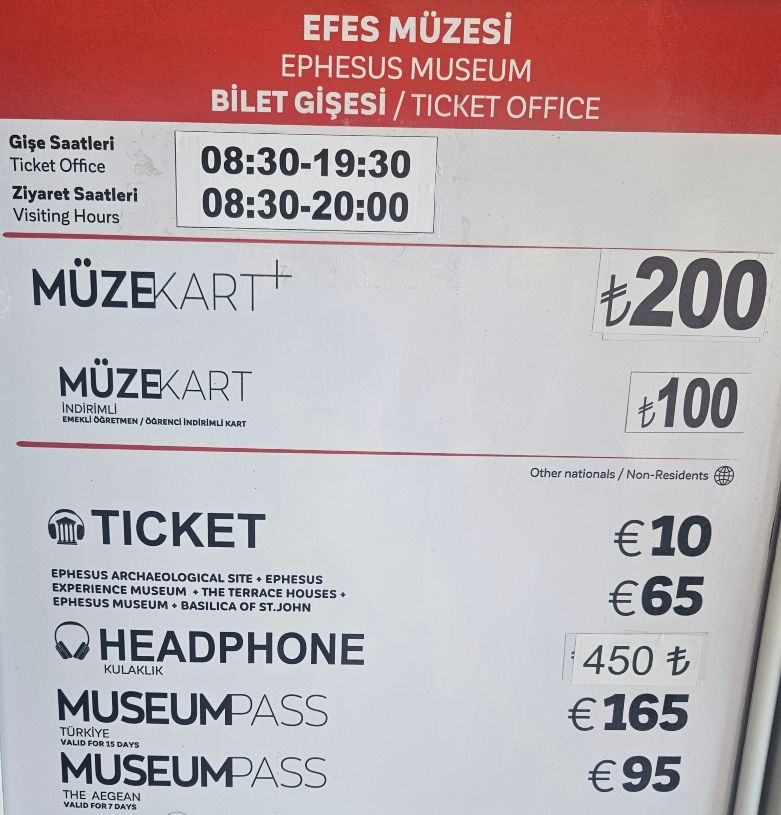
The Ephesus museum is in Selcuk and not at the Ephesus archaeological site. It's open from 08.30 to 20.00 and entry costs EUR 10 payable in Turkish lira. We only needed 40 minutes to view the exhibits so it was expensive for the time spent.
It is a nice museum with interesting exhibits but there's not a lot of information about Ephesus. The museum receives a lot of good reviews but I don't think it's worth visiting.


8. Basilica of St. John & Ayasuluk Fortress
Opening Hours & Entrance Fee
The Basilica of St. John is open from 08.00 to 19.00 and costs EUR 6 (payable in Turkish lira) to enter. The entry ticket gives access to the Ayasuluk Fortress which is open from 09.00 to 17.30 in summer. Google wrongly states that the fortress closes at 16.30.
Brief History of the Basilica of St. John & Ayasuluk Fortress
Saint John spent his last years in Ephesus. He died around 100 AD and was buried on Ayasoluk Hill. There was a commemorative plaque on his grave and in the 4th century AD it was encased in a chapel. In the 6th century AD the Byzantine Emperor Justinian ordered the construction of a huge Basilica on this site.
The construction of the Basilica used stone from the nearby Temple of Artemis and it was completed in 565 AD. The Basilica of Saint John was an important goal for pilgrims as it was believed that the dust from the tomb of the Apostle possessed healing properties.
Ephesus declined after the invasion by the Arabs in the years 654-655 and some of the population relocated to Ayasoluk Hill. A hilltop fortress was built above the Basilica of St. John and it was surrounded by thick walls.
In 1304 the Seljuk Turks invaded the city. The Basilica of St. John was transformed into a mosque and pilgrims had to pay for access to the tomb of St. John. In 1402 the Mongol army invaded the area and the Basilica was destroyed. For over 600 years the ruins of the Basilica lay in oblivion and its stones used for building materials.
How to get there
The Basilica of St. John is a 10 minute uphill walk from Selcuk. The Ayasuluk fortress is accessed by walking through the Basilica. It's uphill again.
When to Visit
We visited Ephesus in the morning and after a rest we visited the Basilica of St. John at 16.30. This meant we didn't run into any tour groups and it wasn't during the hottest part of the day.
The Basilica is open until 19.00 and an even later visit would result in cooler temperatures and less people. However, if you want to see the fortress it closes at 17.30. I personally wouldn't bother seeing the interior of the Ayasuluk Fortress as there is very little to see.
What to see at the Basilica of St. John & Ayasuluk Fortress
The Basilica of St. John is an evocative and beautiful ruin that's worth wandering around. There are a few information boards at the Basilica.
The Ayasuluk Fortress has an impressive exterior which can be seen from the Basilica. There's very little to see inside except for a small mosque and a small covered cistern. It's possible to walk along the ramparts.
We spent one hour wandering around the Basilica and Fortress.


9. Mosque of Isa Bey in Selcuk
The Isa Bey Mosque is situated below the Ayasoluk Castle and the Basilica of St. John. It's one of the best examples of Anatolian mosque architecture. It was built in 1375 using stone and columns from the ruins at Ephesus and the Temple of Artemis. The mosque stood in ruins for many years but was restored in 1970 and reopened for prayer.
The Isa Bey Mosque can be seen when visiting the Basilica of St. John and the Ayasoluk Fortress as it is nearby. The mosque has a very imposing exterior and is accessed through a very pleasant central courtyard. The courtyard is shaded by trees and has Ottoman gravestones resting against the walls.
The interior of the Isa Bey Mosque isn't very special. Modest attire is required; head coverings for women and covered legs for everyone, with wraps available at the entrance.


10. House of Virgin Mary
We didn't visit the House of Virgin Mary as it isn't authentic and is a tourist trap. The following review of the House of Virgin Mary states what many other visitors have expressed:
"Unless you are the most devout Catholic and appreciate locations with the loosest possible claim to fame, this is an absolute money grab and a waste of your time. The house that is supposedly where Mary lived is not an original, it's a rebuilt rock house, you wait in a line to walk through, the time spent walking through the tiny house is mere minutes, there is no stopping inside, no place to sit, you have to keep walking single file through and pictures are not allowed. The walk from the main parking lot is INCREDIBLY steep with no resting places, and is along a road with charter buses driving past you. Save your time and money for Ephesus."

11. Temple of Artemis at Selcuk
The Temple of Artemis is on the outskirts of Selcuk and not at Ephesus. We didn't visit it as all that is left of the Temple of Artemis is one column. A reviewer wrote:
"This is without a doubt the most disappointing archaeological site in Turkey. Considered by those who saw it in ancient times to be better than the pyramids of Giza, better than Babylon and the Colossus of Rhodes we are now left with an arid swamp and a pieced together column. Extremely disappointing, worth stopping off to have a laugh about."


Comments