%20(1).png)
Visiting the Ancient City of Priene
Updated: Jul 23

Priene is one of the best examples of a classical Hellenistic city because it was never overlaid by modern cities or extensively reconstructed by the Romans.
Contents
1. History of Priene
Priene was originally established by Greek colonists near the mouth of the Meander River around the 11th century BC.
By the 4th century BC sediment deposited by the Meander River had silted up Priene's harbour and turned the coastline into unliveable marshland. Around 350 BC the site was abandoned and a new city was constructed on the slopes of Mount Mycale.
The new city of Priene was designed according to the Hippodamian grid plan. Despite the mountain terrain, the city was laid out in a geometric grid of intersecting right-angled streets that divided the town into uniform residential blocks, surrounded by defensive walls.
In 334 BC Alexander the Great visited the newly rebuilt city and financially sponsored Priene’s principal sanctuary, the Temple of Athena, in exchange for an inscription dedicating the temple in his name.
During the Hellenistic period, Priene flourished as a prosperous agricultural and trading centre with around 4,000 to 5,000 residents, complete with a grand theatre, a gymnasium, a bouleuterion (council hall) and an agora.
Priene came under Roman control in 129 BC but remained relatively untouched by Roman architectural interventions. Consequently, it preserved its classical Greek and Hellenistic character.
The Meander River continued its relentless deposition of silt. Over the centuries the Gulf of Latmus was completely silted in, cutting Priene off from the sea and stranding the city miles inland. Priene slowly declined due to the loss of maritime trade.
By the Byzantine era Priene had shrunk into a modest settlement. As the surrounding lands became waterlogged, and prone to malaria, the population dwindled further. By the late 13th century AD Priene was entirely abandoned.
2. How to get to Priene
Entering "Priene Ruins" in Google maps doesn't lead to Priene's car park. The road for the final kilometre isn't shown and instead it shows a path through fields! When we drove to Priene in June 2026 there were also no road signs for the final section of the route.
When Google maps indicates that you have reached Priene drive another 500 metres along the road and then take the first road on the left. The car park and entrance gate is at the end of this road.
3. Best Time to Visit Priene
Priene is rarely frequented by tour buses and there are relatively few visitors. Therefore crowds aren't an issue for determining when to visit.
There are plenty of trees at Priene so heat isn't too much of a concern either. It was 37 degrees centigrade when we visited in mid June and we coped well with the heat. If you can visit earlier or later on summer days it would be better.
4. Opening Hours, Entry Fees and Facilities at Priene
Entry tickets cost EUR 4 and are payable in Turkish lira. Unfortunately I didn't make a note of the opening times but they seem to be from 08.30 to 19.00 in summer.
There is a store selling drinks and there are good toilets at the spacious car park by the entrance.
5. What to see at Priene
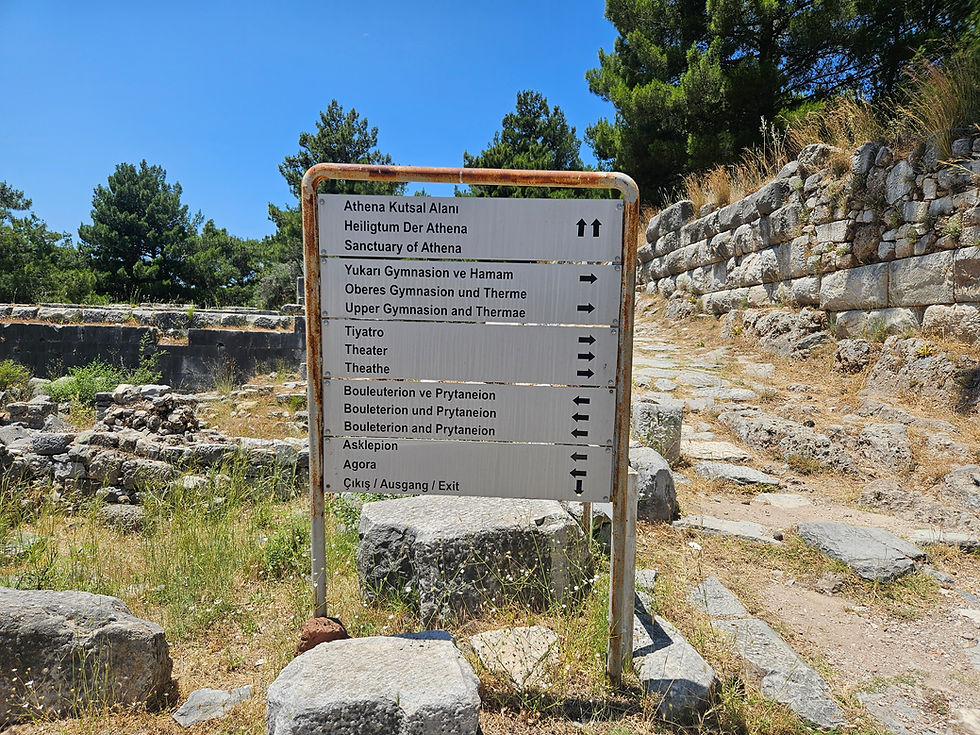
The main ancient structures to see at Priene are the theatre, Sanctuary of Athena and bouleuterion. Priene is well signposted and there are plenty of information boards. The site is fairly compact and we spent 1.5 hours there.
One of the features of Priene is that it was laid out in a geometric grid of intersecting right-angled streets. Unfortunately we didn't gain any impression of that whilst walking around.
The Theatre at Priene
The theatre was built into the hillside at Priene in the 3rd century BC and has 6,500 seats. It is one of the best preserved theatres from Hellenistic times. At the edge of the semi circular orchestra there are 5 marble seats decorated with ivy ornaments. These were seats of honour and were dedicated to the God of the theatre (Dionysos).


Bishop's Church (Byzantine Basilica) at Priene
The Bishop's church was the largest church at Priene and was built in the 5th/6th century AD with stone from older buildings. The church is in front of the theatre and in a nice shady spot!

Sanctuary of Athena at Priene
The Sanctuary of Athena was built in the 4th century BC and was financially sponsored by Alexander the Great. It was the largest temple at Priene.

The Bouleuterion at Priene
The bouleuterion was built around 200 BC and was used for city council meetings.


Comments